
The Angry Monster


Last week, my seven-year-old son was having a difficult moment.
What began as a disagreement with his younger brother quickly escalated. His frustration grew bigger and bigger until it spilled over into a full-blown tantrum. He was shouting, crying, and moving through the house with the kind of anger that makes everything feel breakable.
As an art therapist—and perhaps even more importantly, as a mother—I have learned that reasoning rarely works when a child is already overwhelmed.
So I reached for something else.
A packet of paper clay.
I placed it in front of him and let him do whatever he needed to do.
He squeezed it. Pounded it. Pulled it apart. Cut into it. Flattened it.
There was no expectation to make anything beautiful. No lesson to learn. No pressure to calm down.
Just space for the feeling to exist.
For a while, the clay became the anger.
Then something shifted. The pounding became shaping. The destruction became construction.
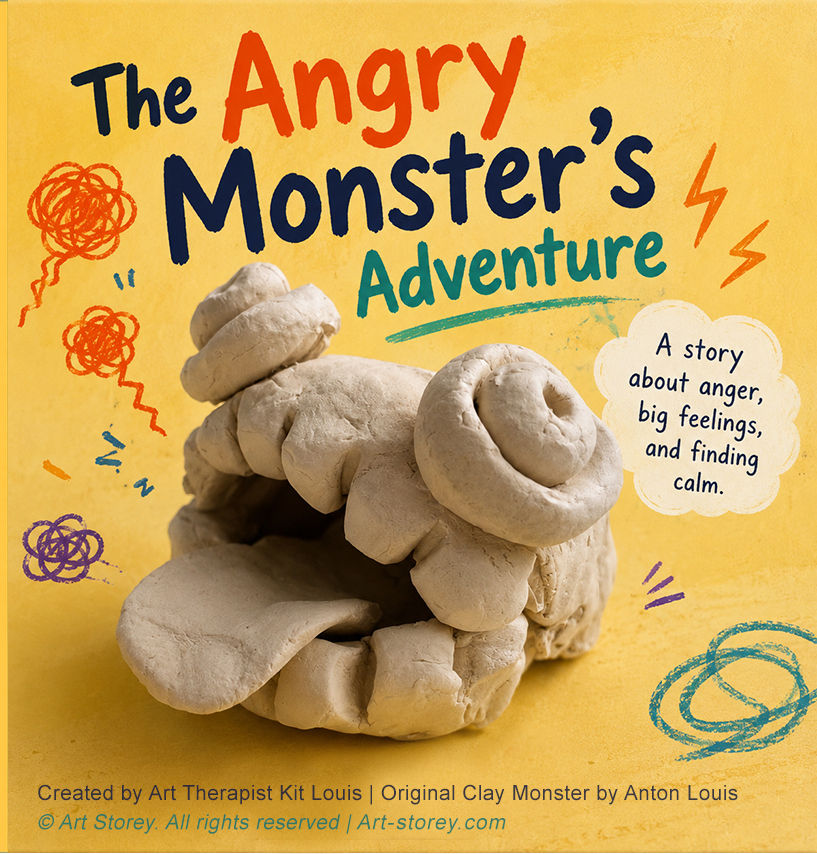
Together, we began creating an angry monster with enormous eyes, rows of teeth, and a long tongue sticking out of its mouth. The anger that had felt so overwhelming a few moments earlier now had a form, a character, and a place to live outside of him.
As I added details to the monster, my son quietly began working on something of his own.

He rolled a small piece of clay into a pinch pot.
"It looks like a volcano," he said.
Then he smiled.
"I'm making it for you."
And just like that, the storm began to pass.
The child who moments earlier had been consumed by anger was now focused, playful, thoughtful, and kind. Before leaving for his tutor lesson and swimming class, he gave me a big squeeze hug and whispered, "Thank you, Mama."
Of course, parenting is not always this neat.
There are many days when emotions stay messy, when siblings continue arguing, and when nobody walks away feeling particularly regulated.
But this moment reminded me of something important.
Children do not always need us to take away their anger.
Sometimes they need us to sit beside it.
To help it take shape.
To show them that big feelings are not dangerous, bad, or wrong.
When emotions are given space, time, and a safe outlet, they often begin to transform on their own.
That afternoon, an angry monster became a clay sculpture.
A tantrum became a memory. And a small volcano became a gift.
Perhaps that is what co-regulation sometimes looks like—not fixing the feeling, but staying close enough to help carry it until it changes form.
The story did not end with the clay monster. Later that night, we turned the experience into a gentle bedtime conversation, using it as an opportunity to explore feelings, empathy, and emotional regulation together. In many ways, the Angry Monster became more than a sculpture—it became a bridge for connection and learning.
If you'd like to continue similar conversations with your own child, you can download our free bedtime story, The Angry Monster, here.

Comments